
Structural Engineer in Provo, Utah
The owner of Crossroads Engineers grew up next door in Orem, so Provo has always been familiar territory. BYU Stadium, the older neighborhoods east of campus, the Tree Streets, Indian Hills, and the climb toward Provo Canyon all have very different kinds of construction and very different structural histories. The rivalry between Orem and Provo High is legendary – at least among the old timers.
One thing that stands out in the engineer’s Provo inspection files is the number of older homes and small apartment buildings. Many date from the 1940s through the 1970s and include heavy brick construction, CMU foundations, and homes that have been converted from single-family use to student housing.
Near 300 West and 1500 North, the engineer inspected a 1949 brick duplex that was actively settling. Cracking and distortion were showing up on all four sides of the structure and inside both living units. Drainage was not especially poor, which made the movement more concerning. Structural piers were recommended around the perimeter to stabilize the building.
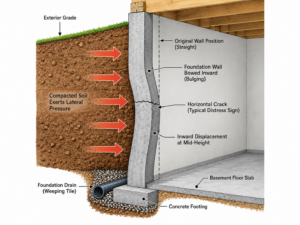
Closer to 700 West and 300 North, the engineer inspected a 1970s six-plex with a different problem. The front corners were rotating downward while a CMU wall on the back side was bulging outward. Structural piers can address vertical settlement, but they do very little for a wall that is rotating or bowing. That building needed both foundation stabilization and a separate framed support system for the failing CMU wall.
Provo also has a lot of remodel work. In the Tree Streets and older neighborhoods near BYU, homes have often been converted, opened up, or modified several times. At one 1960s student-housing property near 600 East and 300 North, a basement window was being enlarged. The important question was not just the size of the opening, but where the load from the wall above was being transferred.
Farther north, near Timpview Drive and Indian Hills, many homes date from the 1960s and 1970s. The engineer has inspected both load-bearing wall removals and roof-framing issues there. Some walls can come out freely because the roof trusses clear-span. Others are carrying floor loads and require an engineered beam.
The hillside areas are another category altogether. Near Brentwood Circle, above the valley and closer to Provo Canyon, the engineer inspected a home where water and unstable hillside soils had caused enough movement that the structure was no longer considered reliable.
Provo is not one structural environment. Old brick, student conversions, CMU foundations, hillside movement, and decades of remodeling all show up here.